03 / The Build Log / Education Platform
CraftCode Academy
A reviewed enrolment platform and teaching system built on React and Supabase.
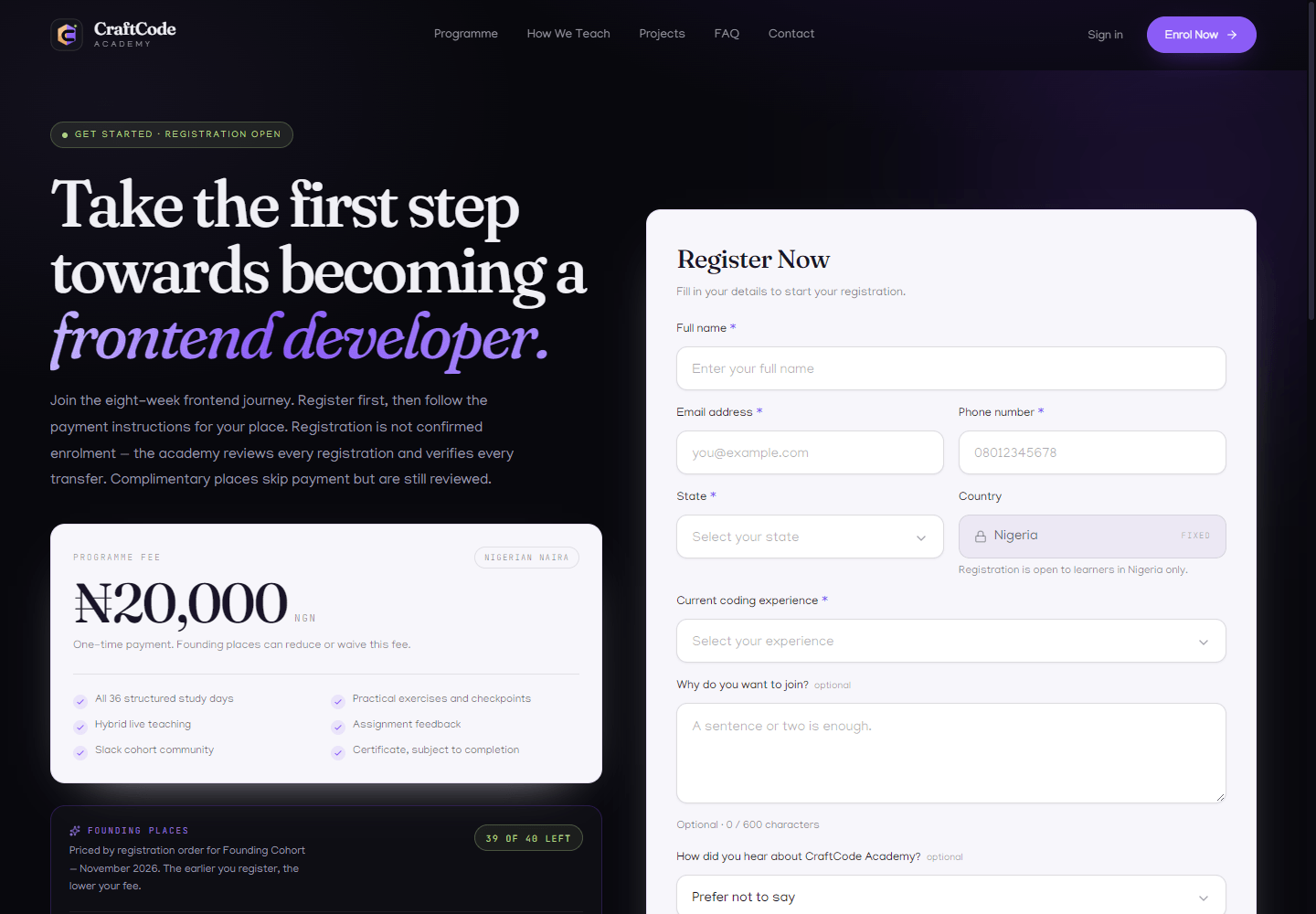
A React and Supabase platform for an eight-week frontend academy: a public programme site, a private receipt pipeline, a learner area with lessons and submissions, and a 39-table administrator console with row-level security and audit trails.
- Role
- Frontend Development · Product Design
- Category
- Education Platform
- Status
- In build
- Year
- 2026
[build: craftcode-academy-build-log] — In build
01 / The brief
Build the academy, not just the brochure.
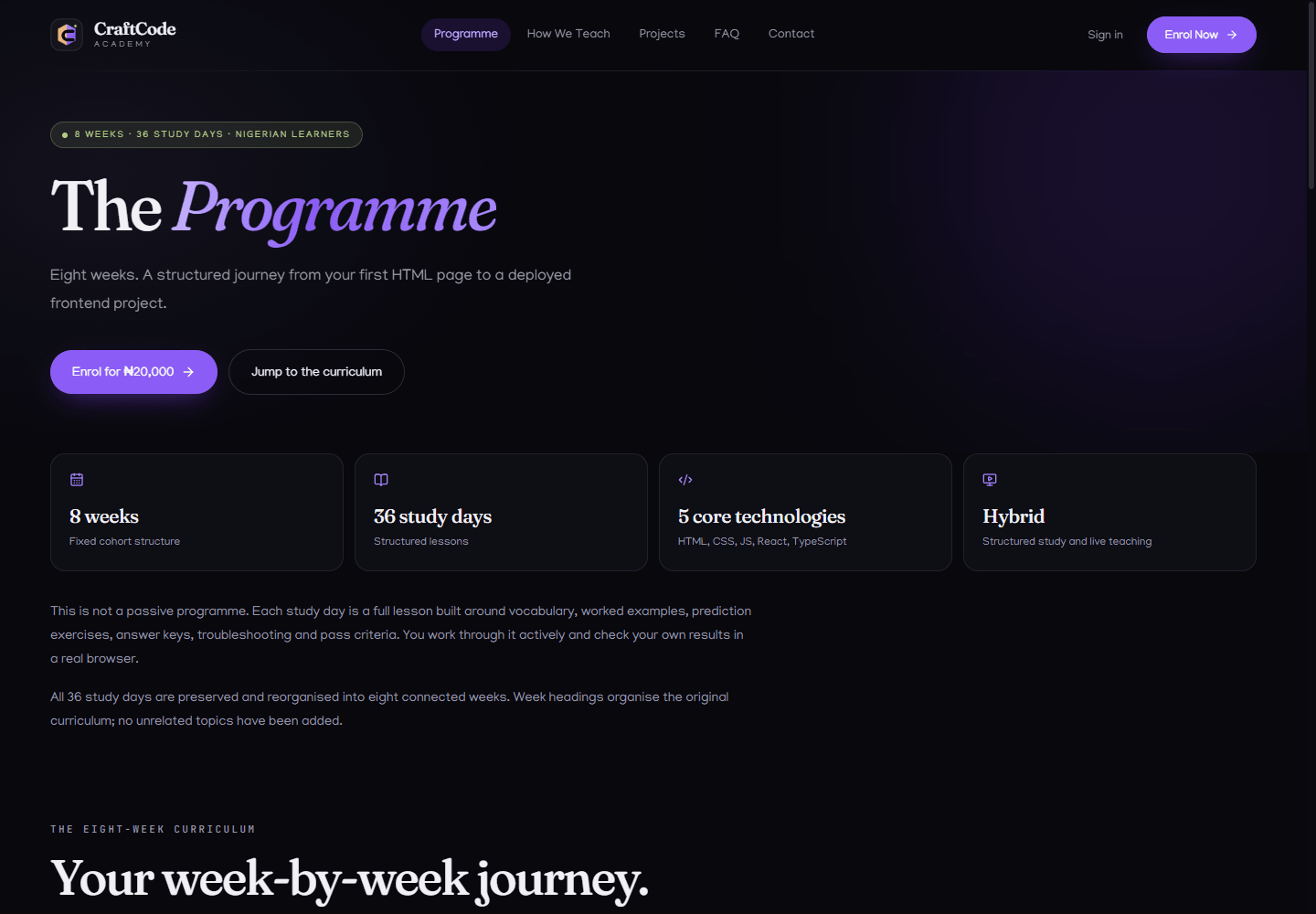
CraftCode Academy needed more than a marketing site. It needed a way to register applicants, accept private proof of a bank transfer, verify that transfer, enrol a learner, deliver a 36-day curriculum, collect assignments, record assessment decisions and handle remediation.
The result is a React single-page application backed by Supabase. The public site and the operating platform share one design system and one repository, but they have separate route trees and separate security expectations.
- Nine public routes under a public layout
- Nine learner routes under an authenticated layout
- Eighteen administrator routes behind a role guard
- 39 database tables, all with row-level security enabled
02 / System map
A static frontend over a guarded database.
React + Vite
Public · learner · admin routes
Supabase Auth
Sessions · profiles · roles
RPC layer
Registration · review · publish
PostgreSQL + RLS
39 tables · 47 functions
Private storage
Receipts · submissions
The browser uses only the anon key. Consequential writes run through security-definer functions that check the caller.
03 / The data model
The schema models the operation, not the page.
Admissions needs profiles, cohorts, registrations, payment submissions, payment evidence and enrolments. Teaching needs weeks, lessons, sections, resources and assignments. Learning needs submissions, versions, files, events and progress.
Assessment needs definitions, versions, criteria, answer keys, evaluation runs, suggested scores, human reviews and publications. Remediation needs cases, items, attempts and events.
All 39 tables enable row-level security. Learners read their own records; administrators read operational data; public visitors read published settings and course content. The database, not the client, decides.
04 / The enrolment pipeline
A sequence of guarded functions.
Each step is a database function with its own validation, not a sequence of permissive table writes.
- 01
submit_registration
Validates details, enforces one registration per email, generates a reference and computes the amount due.
- 02
submit_payment
Records transfer details and links evidence uploaded to the private payment-evidence bucket.
- 03
review_payment
Checks is_admin(), verifies the record, creates the enrolment and writes an audit event.
- 04
get_registration_status
Returns only the status a reference and email are entitled to see.
05 / Curriculum as data
Publishing a week has to publish the teaching inside it.
Weeks, lessons and sections are rows. A section can be private, so answer keys never appear in the learner view. Publishing validates that every lesson has a title and at least one learner-visible section, then publishes the week and its draft lessons together.
The Week 1 pilot imported 100 corrected sections through a Python importer that reconstructs paragraphs, carries prose across page boundaries and preserves wrapped table cells.
The source material contains a numbering problem in Day 1 Guided practice. It was left verbatim rather than silently rewritten, because teaching content should be corrected deliberately.
06 / Selected screens
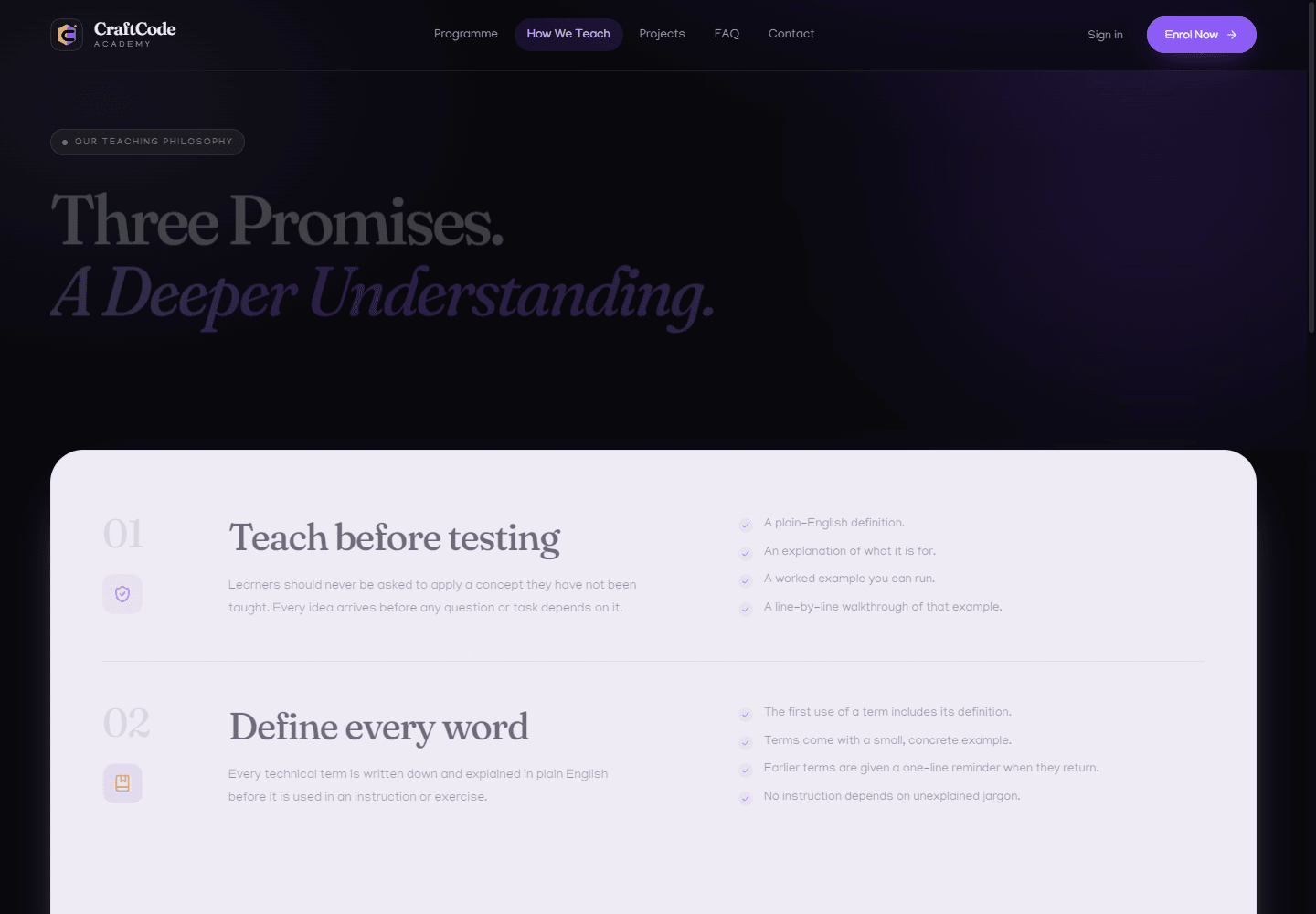
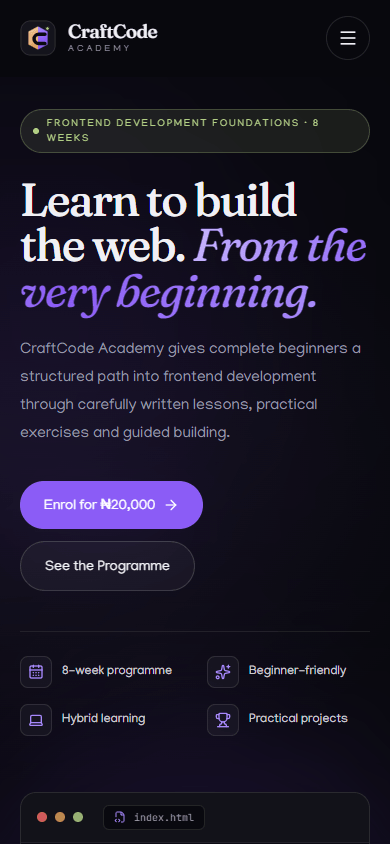
The public face and the working surface.
07 / The hard parts
The hard parts are the states between happy and done.
Receipts are private by default. Admin access uses 120-second signed links, and the bucket rejects public reads. That makes every review slightly slower and prevents a class of data leak.
Assessment deliberately separates a suggested score from a human decision, and review from publication. A result can be corrected before the learner sees it.
Release state is the other hard part. Revisions 1.6–1.19 are built and tested but uncommitted and undeployed. The documentation states that gap rather than presenting the working tree as live.
The project also records its own defects: an enrolment badge that can contradict a closed status, cohort dates that do not propagate publicly, and missing archive and revocation interfaces.
08 / Reflection
Security posture is a product decision.
The most important engineering choice was to keep consequential writes inside security-definer functions and to let row-level security, not the interface, decide who can read a record. That choice makes the product slower to build and much easier to reason about.
The second was to model the teaching process instead of storing rich text. Submissions, criteria, reviews, publications and remediation all have state, and state has to be recorded.
The part I would change is the amount of platform built before the first cohort. The QA book is strong, but it tests the product against its own expectations. Real teaching will produce better requirements than another admin screen.
RLS everywhere
39 of 39 tables enabled; learner visibility encoded in functions.
Private evidence
No public receipt URLs; 120-second signed links only.
Auditable actions
Content revisions, audit logs, submission, review and remediation events.
Honest release state
Live revisions and working-tree revisions documented separately.
09 / What is next
Close the gap between built and shipped.
The next engineering milestone is a release, not a feature: run the full regression, confirm the administrator review-to-publication leg, commit revisions 1.6–1.19 and verify the deployed bundle contains them. Migration 019 is already applied; the Phase 2 application code is not deployed.
After release, the highest-value work is authenticated end-to-end coverage for the learner and administrator journeys, and Slack delivery or explicit removal from scope.
- Record the current 94-test result and build in the QA book
- Fix the enrolment badge and cohort-date defects
- Add authenticated learner and admin E2E tests
- Exercise the learner profile page with a learner session
- Deploy only after explicit authorisation
Next in The Build Log
HelsaGrace Portfolio
A Next.js 15 and React 19 portfolio built around two records: a registry-driven case study system with a shared block renderer, an optional Supabase admin, and project documentation generated from Markdown into typed entries.